Home of Veshom Cavalry Regiment

Wednesday, 26 June 2024

Cowboy and Moscow on a Train

 A Cowboy from Montana rode on a train

Saw a man from Moscow on the way to Ukraine

They talked about business and family and wife

They thought their outlook alike in their life 


"My cattle are life" Cowboy said from under his is hat

 My property, My food,  My wealth, my plat

I steward their growth for my family and deeds

But I spend them like money when there is a need


"My peasants and migrants, and vatniks" Moscow  said

 "Are much like your cattle" I spend in my stead

When I grow the land to make Moscow thrive 

  They're the people I harvest to keep me alive


I spend them like money when there is a need

to expand my lands and Muscovy's creed

They're the  meat that I send to die in the battle

They're the meat I replace with Ukrainian chattel


The captured go east to grow in the bad lands

to replace the meat that I spent to expand

You must see and agree that our goals are the same

They're our property, food, our wealth, our gain


The Cowboy stood, stretched his legs and his boots

and looked at Moscow from his head to his roots

"This old story I've heard, now I hear from your side"

He looked off in the distance, for a while, then replied


"My  parents were Russian,  told me stories that roared,

About tax collectors for the Golden Horde

They made slaves of their own, stole taxes to pay

even after the Horde had moved far away


That's the reason I'm on my way to Ukraine

bringing tanks and bullets to clean Russian stain

 people and cattle, you don't treat them the same

I'm here so Moscow can't confuse them again


and Cowboy threw Moscow off of the train

"People are people" I heard Cowboy say

and cattle are cattle, now you have a nice day


Saturday, 1 June 2024

Problem Solving Domains

 Steps

Recognizing and Defining a Problem

Know your context

Developing Courses of Action

Assess Courses of Action

Selecting Course of  action

Evaluate Results


Characteristics influencing Skills

  • Critical Thinking Practice
  • Sense of  Agency
  • Judgement - Ballance of Bravery and safety
  • Decisiveness
  • Diverse roles
  • Training in Logic


Problem Solving: Question 2: Defining an actionable problem Question

 Nonactionable Problem Statements

  1. Disorder: Russia is Invading Ukraine, what do we do?
  2. Obvious: Why does it take forever to hire someone?
  3. Complicated: Why does this pump keep failing?   
  4. Chaotic: Why is their water pouring into my Basement


Actionable Problem Statements

  1. Disorder: Russia is Invading Ukraine, what must we do to stop their progress at the river?
  2. Obvious: What is the most efficient way to hire someone?
  3. Complicated:  How many times has this pump died in the last 2 years, and what else was going on in the plant at the time? what are the design specifications of the pump?
  4. Chaotic: What is the source of water coming into my my basement what must I don to stabilize it?

Problem Solving: Question 1 In what Context Does Problem Occur?


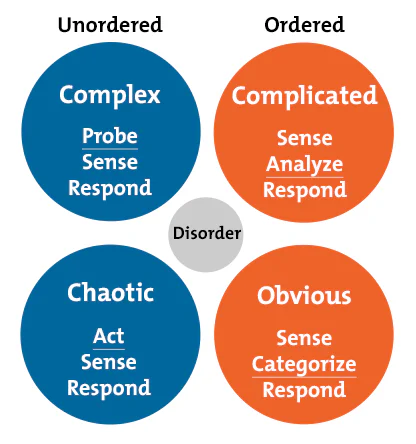
  • Cynefin  (Kum-nifin)Framework for Problem solving models says that Problems happen in 4 contexts, Complex, Chaotic, Complicated, and Obvious, and problem solving in each context requires different actions in different orders.
Complex and Chaotic contexts are characterize by "Unordered


Obvious Contexts – "The Domain of Best Practice"

In "obvious" contexts, your options are clear and cause-and-effect relationships are apparent to everyone involved.

Here, there are often explicit steps in place that dictate the next stage of the process. For example, problems encountered at help desks or call centers are often predictable, and there are processes in place to handle most of them.

Snowden argues that you need to "Sense – Categorize – Respond" to obvious decisions. Put simply, you should assess the situation, categorize its type, and then base your response on best practice. There is often one established "correct" answer, based on an existing process or procedure.

However, there is a danger that obvious contexts may be oversimplified. This often happens when leaders, or an entire organization, experience success and then become complacent. To avoid this, make sure that there are clear communication channels in place, so that team members can report any situations that don't fit with any established category.

Another challenge is that leaders may not be receptive to new ideas because of past experiences and success. For example, some people might automatically assume that previous solutions will work again. To overcome this, stay open to new ideas and be willing to pursue innovative suggestions.


Obvious Context

Snowden argues that you need to "Sense – Categorize – Respond" to obvious decisions. Put simply, you should assess the situation, categorize its type, and then base your response on best practice. There is often one established "correct" answer, based on an existing process or procedure.


Complicated Contexts – "The Domain of Experts"

"Complicated" problems might have several "correct" solutions. Here, there is a clear relationship between cause and effect, but it may not be visible to everyone, because the problem is... complicated. For example, you might see several symptoms of a problem but not know how to fix it.

The decision-making approach here is to "Sense – Analyze – Respond." In other words, you need to assess the situation, analyze what is known (often with the help of experts), and decide on the best response, using good practice.

Leaders may rely too heavily on experts in complicated situations, while dismissing or overlooking creative solutions from other people. To overcome this, assemble a team of people from a wide variety of background

Complex Context

"Complicated" problems might have several "correct" solutions. Here, there is a clear relationship between cause and effect, but it may not be visible to everyone, because the problem is... complicated. For example, you might see several symptoms of a problem but not know how to fix it.

The decision-making approach here is to "Sense – Analyze – Respond." In other words, you need to assess the situation, analyze what is known (often with the help of experts), and decide on the best response, using good practice.


Complex Contexts – "The Domain of Emergence"

It might be impossible to identify one "correct" solution, or spot cause-and-effect relationships, in "complex" situations. According to Snowden and Boone, many business situations fall into this category.

Complex contexts are often unpredictable, and the best approach here is to "Probe – Sense – Respond." Rather than trying to control the situation or insisting on a plan of action, it's often best to be patient, look for patterns, and encourage a solution to emerge.

Chaotic Contexts – "The Domain of Rapid Response"

In "chaotic" situations, no relationship between cause and effect exists, so your primary goal is to establish order and stability. Crisis and emergency scenarios often fall into this domain.

The decision-making approach here is to "Act – Sense – Respond." You need to act decisively to address the most pressing issues, sense where there is stability and where there isn't, and then respond to move the situation from chaos to complexity.

To navigate chaotic situations successfully, conduct a Risk Analysis


https://www.mindtools.com/atddimk/the-cynefin-framework

 https://www.mindtools.com/atddimk/the-cynefin-framework

Thursday, 30 May 2024

Cognitive Warfare Inoculation Resources


Recognizing Manipulation  through conversations attempts

 Videos from Truth Lab

  1. https://osf.io/adf98    Emotional Language -Manipulation Red Flag
  2. https://osf.io/6d8eu      Incoherent Language rage against both sides -Manipulation Red Flag
  3. https://osf.io/9csqy       False Dichotomies ( though truth is not in the gray) - Manipulation Red Flag
  4. https://osf.io/hfjqw       Scapegoating  - assigning blame to the wrong place- Manipulation Red Flag
  5. https://osf.io/zyhbs       Ad Hominin attacks  - calling names to illicit reponse - Manipulation Red Flag

Recognizing Manipulation through relationship attempts

  1. 60-40 Trolling          Semi Trustworthy relationships Aim-Become a trusted source
  2. Pied Piper Trolling    False Friendships                     Aim-Become a trusted source
  3. Tired Head Trolling  Gaslighting Friendships           Aim-create a lack of trust ion all relationships


https://www.science.org/doi/10.1126/sciadv.abo6254

Coignitive Resilience in Propaganda


Online misinformation continues to have adverse consequences for society. Inoculation theory has been put forward as a way to reduce susceptibility to misinformation by informing people about how they might be misinformed, but its scalability has been elusive both at a theoretical level and a practical level. We developed five short videos that inoculate people against manipulation techniques commonly used in misinformation: emotionally manipulative language, incoherence, false dichotomies, scapegoating, and ad hominem attacks. In seven preregistered studies, i.e., six randomized controlled studies (n = 6464) and an ecologically valid field study on YouTube (n = 22,632), we find that these videos improve manipulation technique recognition, boost confidence in spotting these techniques, increase people’s ability to discern trustworthy from untrustworthy content, and improve the quality of their sharing decisions. These effects are robust across the political spectrum and a wide variety of covariates. We show that psychological inoculation campaigns on social media are effective at improving misinformation resilience at scale.


For this study, we designed five short, animated inoculation videos in partnership with Google Jigsaw, each exposing a manipulation technique commonly encountered on social media and in other online environments. These videos were designed to “inoculate” people against being misled by flawed argumentation used in common online misinformation, such as excessively emotional language with an aim to invoke anger or outrage (22). In seven preregistered studies (and one pilot study), we tested the efficacy of each of these videos using a randomized controlled design. The pilot study (n = 194; see table S2 for the main results) was conducted with the emotional language video to validate our stimuli sets and outcome measures. The only difference of note between the pilot and the final studies is that in the pilot, we used “credibility” instead of “trustworthiness” as the third outcome measure (the reason for changing it from credibility to trustworthiness is because this term is associated with source or messenger credibility, and since we removed all source information from our stimuli, pilot study participants may have found the use of this outcome measure somewhat confusing). Additional information including the full datasets, analysis and visualization scripts, Qualtrics surveys, and our stimuli can be found on our OSF page: https://osf.io/3769y/. The videos can be viewed on https://inoculation.science.


https://www.science.org/doi/10.1126/sciadv.abo6254

Toward building Cognitive Resilience KSAs

Cognitive Resilience:

Cogwar Defensive Activities


OODA Cycle ( War model)

Problem Processing: Cycle

  • O Observe

  • O Orient,

    • adjust,

    • analysise

    • integrate

  • Decide

  • A  Act

Emotion processing

  • change their facial expressions and vocal tone

  • suppress their thoughts,

  • increase or decrease their physiological arousal,

  • change their subjective feelings.

Exposure time regulation

      • Assessment
      • Counter Warfare activities 

          Injury Mitigation        

      • OODA Cycle


Cognitive Warfare

https://psu.pb.unizin.org/psych425/chapter/process-model-of-emotion-regulation/#:~:text=This%20model%20identifies%20five%20emotion%20regulation%20strategies%20that,modification%2C%20attentional%20deployment%2C%20cognitive%20change%2C%20and%20response%20modulation.

Transaction Theory "Coping"https://www.mindtools.com/atddimk/the-cynefin-framework

The original Transactional Theory outlined three ways of coping:

  1. emotion- Emotion-focused coping refers to coping strategies intended to regulate the emotional responses to the stressor, 
  2. problem-focused coping: strategies are used with the intention of impacting on or altering the stressor itself 
  3. meaning-focused coping- . When stressors persist despite the activation of problem- and emotion-focused coping, meaning-focussed coping strategies are initiated 

  • (Lazarus and Folkman, 1984). while  (Lazarus and Folkman, 1984). However, Folkman (1997) later added a third category of coping, meaning-focussed coping. When stressors persist despite the activation of problem- and emotion-focussed coping, meaning-focussed coping strategies are initiated (Folkman, 2008). This involves the use of beliefs, values and existential goals to find meaning in stressful encounters and to sustain coping efforts (Folkman, 2008). This addition may prove to be particularly relevant to the management of stress in military settings, as discussed below.

  • Domain stating List for KSA


  • Cynefin  (Kum-nifin)Framework for Problem solving models says that Probmes happen in 4 contexts, Complex, Chaotic, Complicated, and Obvious, and problem solving in each context requires different actions in different orders.
Complex and Chaotic contexts are characterize by "Unordered


Obvious Contexts – "The Domain of Best Practice"

In "obvious" contexts, your options are clear and cause-and-effect relationships are apparent to everyone involved.

Here, there are often explicit steps in place that dictate the next stage of the process. For example, problems encountered at help desks or call centers are often predictable, and there are processes in place to handle most of them.

Snowden argues that you need to "Sense – Categorize – Respond" to obvious decisions. Put simply, you should assess the situation, categorize its type, and then base your response on best practice. There is often one established "correct" answer, based on an existing process or procedure.

However, there is a danger that obvious contexts may be oversimplified. This often happens when leaders, or an entire organization, experience success and then become complacent. To avoid this, make sure that there are clear communication channels in place, so that team members can report any situations that don't fit with any established category.

Another challenge is that leaders may not be receptive to new ideas because of past experiences and success. For example, some people might automatically assume that previous solutions will work again. To overcome this, stay open to new ideas and be willing to pursue innovative suggestions.


Obvious Context

Snowden argues that you need to "Sense – Categorize – Respond" to obvious decisions. Put simply, you should assess the situation, categorize its type, and then base your response on best practice. There is often one established "correct" answer, based on an existing process or procedure.


Complicated Contexts – "The Domain of Experts"

"Complicated" problems might have several "correct" solutions. Here, there is a clear relationship between cause and effect, but it may not be visible to everyone, because the problem is... complicated. For example, you might see several symptoms of a problem but not know how to fix it.

The decision-making approach here is to "Sense – Analyze – Respond." In other words, you need to assess the situation, analyze what is known (often with the help of experts), and decide on the best response, using good practice.

Leaders may rely too heavily on experts in complicated situations, while dismissing or overlooking creative solutions from other people. To overcome this, assemble a team of people from a wide variety of background

Complex Context

"Complicated" problems might have several "correct" solutions. Here, there is a clear relationship between cause and effect, but it may not be visible to everyone, because the problem is... complicated. For example, you might see several symptoms of a problem but not know how to fix it.

The decision-making approach here is to "Sense – Analyze – Respond." In other words, you need to assess the situation, analyze what is known (often with the help of experts), and decide on the best response, using good practice.


Complex Contexts – "The Domain of Emergence"

It might be impossible to identify one "correct" solution, or spot cause-and-effect relationships, in "complex" situations. According to Snowden and Boone, many business situations fall into this category.

Complex contexts are often unpredictable, and the best approach here is to "Probe – Sense – Respond." Rather than trying to control the situation or insisting on a plan of action, it's often best to be patient, look for patterns, and encourage a solution to emerge.

Chaotic Contexts – "The Domain of Rapid Response"

In "chaotic" situations, no relationship between cause and effect exists, so your primary goal is to establish order and stability. Crisis and emergency scenarios often fall into this domain.

The decision-making approach here is to "Act – Sense – Respond." You need to act decisively to address the most pressing issues, sense where there is stability and where there isn't, and then respond to move the situation from chaos to complexity.

To navigate chaotic situations successfully, conduct a Risk Analysis


https://www.mindtools.com/atddimk/the-cynefin-framework

 https://www.mindtools.com/atddimk/the-cynefin-framework