Home of Veshom Cavalry Regiment

Thursday, 30 May 2024

Coignitive Resilience in Propaganda


Online misinformation continues to have adverse consequences for society. Inoculation theory has been put forward as a way to reduce susceptibility to misinformation by informing people about how they might be misinformed, but its scalability has been elusive both at a theoretical level and a practical level. We developed five short videos that inoculate people against manipulation techniques commonly used in misinformation: emotionally manipulative language, incoherence, false dichotomies, scapegoating, and ad hominem attacks. In seven preregistered studies, i.e., six randomized controlled studies (n = 6464) and an ecologically valid field study on YouTube (n = 22,632), we find that these videos improve manipulation technique recognition, boost confidence in spotting these techniques, increase people’s ability to discern trustworthy from untrustworthy content, and improve the quality of their sharing decisions. These effects are robust across the political spectrum and a wide variety of covariates. We show that psychological inoculation campaigns on social media are effective at improving misinformation resilience at scale.


For this study, we designed five short, animated inoculation videos in partnership with Google Jigsaw, each exposing a manipulation technique commonly encountered on social media and in other online environments. These videos were designed to “inoculate” people against being misled by flawed argumentation used in common online misinformation, such as excessively emotional language with an aim to invoke anger or outrage (22). In seven preregistered studies (and one pilot study), we tested the efficacy of each of these videos using a randomized controlled design. The pilot study (n = 194; see table S2 for the main results) was conducted with the emotional language video to validate our stimuli sets and outcome measures. The only difference of note between the pilot and the final studies is that in the pilot, we used “credibility” instead of “trustworthiness” as the third outcome measure (the reason for changing it from credibility to trustworthiness is because this term is associated with source or messenger credibility, and since we removed all source information from our stimuli, pilot study participants may have found the use of this outcome measure somewhat confusing). Additional information including the full datasets, analysis and visualization scripts, Qualtrics surveys, and our stimuli can be found on our OSF page: https://osf.io/3769y/. The videos can be viewed on https://inoculation.science.


https://www.science.org/doi/10.1126/sciadv.abo6254

Toward building Cognitive Resilience KSAs

Cognitive Resilience:

Cogwar Defensive Activities


OODA Cycle ( War model)

Problem Processing: Cycle

  • O Observe

  • O Orient,

    • adjust,

    • analysise

    • integrate

  • Decide

  • A  Act

Emotion processing

  • change their facial expressions and vocal tone

  • suppress their thoughts,

  • increase or decrease their physiological arousal,

  • change their subjective feelings.

Exposure time regulation

      • Assessment
      • Counter Warfare activities 

          Injury Mitigation        

      • OODA Cycle


Cognitive Warfare

https://psu.pb.unizin.org/psych425/chapter/process-model-of-emotion-regulation/#:~:text=This%20model%20identifies%20five%20emotion%20regulation%20strategies%20that,modification%2C%20attentional%20deployment%2C%20cognitive%20change%2C%20and%20response%20modulation.

Transaction Theory "Coping"https://www.mindtools.com/atddimk/the-cynefin-framework

The original Transactional Theory outlined three ways of coping:

  1. emotion- Emotion-focused coping refers to coping strategies intended to regulate the emotional responses to the stressor, 
  2. problem-focused coping: strategies are used with the intention of impacting on or altering the stressor itself 
  3. meaning-focused coping- . When stressors persist despite the activation of problem- and emotion-focused coping, meaning-focussed coping strategies are initiated 

  • (Lazarus and Folkman, 1984). while  (Lazarus and Folkman, 1984). However, Folkman (1997) later added a third category of coping, meaning-focussed coping. When stressors persist despite the activation of problem- and emotion-focussed coping, meaning-focussed coping strategies are initiated (Folkman, 2008). This involves the use of beliefs, values and existential goals to find meaning in stressful encounters and to sustain coping efforts (Folkman, 2008). This addition may prove to be particularly relevant to the management of stress in military settings, as discussed below.

  • Domain stating List for KSA


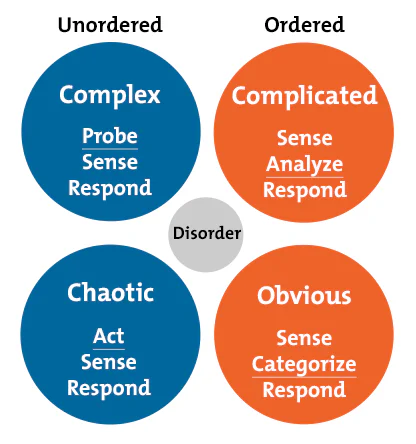
  • Cynefin  (Kum-nifin)Framework for Problem solving models says that Probmes happen in 4 contexts, Complex, Chaotic, Complicated, and Obvious, and problem solving in each context requires different actions in different orders.
Complex and Chaotic contexts are characterize by "Unordered


Obvious Contexts – "The Domain of Best Practice"

In "obvious" contexts, your options are clear and cause-and-effect relationships are apparent to everyone involved.

Here, there are often explicit steps in place that dictate the next stage of the process. For example, problems encountered at help desks or call centers are often predictable, and there are processes in place to handle most of them.

Snowden argues that you need to "Sense – Categorize – Respond" to obvious decisions. Put simply, you should assess the situation, categorize its type, and then base your response on best practice. There is often one established "correct" answer, based on an existing process or procedure.

However, there is a danger that obvious contexts may be oversimplified. This often happens when leaders, or an entire organization, experience success and then become complacent. To avoid this, make sure that there are clear communication channels in place, so that team members can report any situations that don't fit with any established category.

Another challenge is that leaders may not be receptive to new ideas because of past experiences and success. For example, some people might automatically assume that previous solutions will work again. To overcome this, stay open to new ideas and be willing to pursue innovative suggestions.


Obvious Context

Snowden argues that you need to "Sense – Categorize – Respond" to obvious decisions. Put simply, you should assess the situation, categorize its type, and then base your response on best practice. There is often one established "correct" answer, based on an existing process or procedure.


Complicated Contexts – "The Domain of Experts"

"Complicated" problems might have several "correct" solutions. Here, there is a clear relationship between cause and effect, but it may not be visible to everyone, because the problem is... complicated. For example, you might see several symptoms of a problem but not know how to fix it.

The decision-making approach here is to "Sense – Analyze – Respond." In other words, you need to assess the situation, analyze what is known (often with the help of experts), and decide on the best response, using good practice.

Leaders may rely too heavily on experts in complicated situations, while dismissing or overlooking creative solutions from other people. To overcome this, assemble a team of people from a wide variety of background

Complex Context

"Complicated" problems might have several "correct" solutions. Here, there is a clear relationship between cause and effect, but it may not be visible to everyone, because the problem is... complicated. For example, you might see several symptoms of a problem but not know how to fix it.

The decision-making approach here is to "Sense – Analyze – Respond." In other words, you need to assess the situation, analyze what is known (often with the help of experts), and decide on the best response, using good practice.


Complex Contexts – "The Domain of Emergence"

It might be impossible to identify one "correct" solution, or spot cause-and-effect relationships, in "complex" situations. According to Snowden and Boone, many business situations fall into this category.

Complex contexts are often unpredictable, and the best approach here is to "Probe – Sense – Respond." Rather than trying to control the situation or insisting on a plan of action, it's often best to be patient, look for patterns, and encourage a solution to emerge.

Chaotic Contexts – "The Domain of Rapid Response"

In "chaotic" situations, no relationship between cause and effect exists, so your primary goal is to establish order and stability. Crisis and emergency scenarios often fall into this domain.

The decision-making approach here is to "Act – Sense – Respond." You need to act decisively to address the most pressing issues, sense where there is stability and where there isn't, and then respond to move the situation from chaos to complexity.

To navigate chaotic situations successfully, conduct a Risk Analysis


https://www.mindtools.com/atddimk/the-cynefin-framework

 https://www.mindtools.com/atddimk/the-cynefin-framework

Wednesday, 29 May 2024

7 Domains of Resilience

1. Competence – is the ability to know how to handle stressful situations effectively. It requires having the skills to face challenges, and having had the opportunity to practice using these skills so that one feels competent in dealing with situations. Our groups offer stress-reduction and social skills training and by learning these skills in a group of similar aged peers, provides the opportunity for your child to practice these skills, and enhance their competence.

2. Confidence – is the belief in one’s own abilities and is rooted in competence. Children gain confidence by being able to demonstrate their competence in real situations. Our groups enhance self-confidence by identifying each child’s individual strengths and when children are noticed for their strengths, watch them soar high and be self-motivated to overcome their challenges.

3. Connection – children with close ties to friends, family, and community groups are likely to have a stronger sense of security and sense of belonging. These children are more likely to have strong values and are less likely to seek out alternative destructive behaviours. In our groups, we foster a sense of belonging and we discuss ways your children can strengthen their ties by being a good friend, a caring family member, and an important community member

4. Character – children with “character” enjoy a strong sense of self-worth and confidence. They are in touch with their values and are comfortable sticking to them. They can demonstrate a caring attitude towards others. They have a strong sense of right and wrong and are prepared to make wise choices and contribute to the world. Our groups aim to strengthen character through enhancing self-esteem with our strengths-based work, and by teaching skills of empathy and caring for others. In our youth group, teenagers are empowered to recognise that they have the ability to make choices and that they can make “wise” choices towards their values rather than away from their values.

5. Contribution – if children can experience personally contributing to the world, they can learn the powerful lesson that the world is a better place because they are in it. Hearing the thank you’s and appreciation when your child contributes, will increase their willingness to take actions and make choices that improve the world, thereby enhancing their own competence, character, and sense of connection. In our groups, there will be time for your child to explore how they can contribute and matter in this world. In our parent group session we give lots of ideas on projects that families may be able to do together in order to experience the power of contributing.

6. Coping – children who have a wide repertoire of coping skills (social skills, stress reduction skills) are able to cope more effectively and are better prepared to overcome life’s challenges. Our resilience groups teach both stress-reduction skills and social skills for coping with everyday life stresses.

7. Control – when children realise that they have control over their decisions and actions, they are more likely to know how to make choices in a way that they can bounce back from life’s challenges. Our groups aim to provide children a sense that they have choices – on how they wish to think and act, and that they can determine results based on these choices.


https://cbtprofessionals.com.au/the-importance-of-peer-relationships-during-adolescence-navigating-friendships/

neuro-strike weapons


https://www.tampabay.com/news/nation-world/2023/11/04/haley-china-neuro-strike-weapons-magnets-brain-nervous-system-politifact/

Toward the Knowledge skills and Abilities (KSAs) of Cognitive Resilience


  • In cognitive warfare, the human mind becomes the battlefield. The aim is to change not only what people think, but how they think and act. Waged successfully, it shapes and influences individual and group beliefs and behaviors to favor an aggressor’s tactical or strategic objectives.

  • -NATO

  • This kind of warfare is begin waged at all populations, especially inside of Western Liberal Democracies Western Liberal Democracies (WLDs). continuously. 

  • Most of us are unaware

Cognitive Resilience is an essential survival skill for the 21st century. There are deliberate and unintended consequences of our activites that assuault our abilitty to think, maked ecsion, 

About Cognitive Warfare
  1.  There is a field of Study in Psychology and Neuroscience about Resilience, which includes Cognitive Resilience- unrelate to warfare - that is about recovery from difficulty and injury.
  2. Cognitive warfare seems to be loosely thrown in as a subset of information warfare as taught by Media and information types -all mention  the importance of  but do not adress any methods to strengthen cognitive Resilience.
  3. Western militaries around the world, and NATO, and Anti-western military cooperation groups have developed warfighting doctrine which includes the concept of Cognitive warfare they call Cogwar. they have developed both Offensive and defensive doctrine and tactics. -all mention  the importance of  but do not adress any methods to strengthen cognitive Resilience
  4. This warfare is ongoing now, and has been for 15 or 20 years everywhere
  5. Aimed internally by authoritarian states to manage the beliefs and thinking of their own populations.
  6. Aimed xternally at non-military nations, subgroups, military types, religious and political groups, different age demographics 
  7. It appears about 1/3 of any population is highly susceptible to cognitive warfare.
About the state of  ongoing Wars
  1. There are Nation states which make no conceptual division between war and peace. 
  2. Some have chosen to band together to resist Western liberal Democracy and their cultural  features.
  3. There is, at least, an informal and or opportunistic coordination between these groups, 
    1. China, Russia, Iran, North Korea
    2. Houthis, Hezbollah, Hamas, 
    3. They are reaching out to states in Africa
      1. CAR
      2. Niger
      3. South Africa
    4. Cognitive warfare is underway in those countries to expand their world Views, including starting Russian Style Troll Farms in Africa, to make their Cogwar more culturally appropriate- we have seen those accounts being trained regarding Ulraine war, and aimed at recruiting foreign fighters to be used in Ukraine
  4. Western Liberal Democracies, (WLDs) except for the military and security services, havenot grasped that This group is already at war with us, according to their definitions of war.


About WLDs aiming Cogwar at its own people

  1. Cogwar is aimed internally during election cycles, and they are having more impact every US federal cycle. How these activities are funded and what they are doing needs transparency
  2. informal grass roots troll networks are emerging with their own sometimes competing agendas
  3. This is in addition to the Cogwar aimed at WLD populations from external actors
  4. There is an interaction that occurs when candidates and parties create competing platforms, that external Cogwar Agents amplify into raging divergent opposition within the population.

https://en.wikipedia.org/wiki/GIS_Arta

Conclusion so far

While I hope that there are classified Cognitive Resilience Developments (CRD) underway with Military members who are working in this area ,there appear to be no structural CRD efforts underway as of 5-29-24

our WLD populations are currently largely defenseless against Cogwar assaults, and about a third of us are highly vulnerable to foreign adversaries that have chosen to be at war with us without notice, and without our knowledge.

Next Steps

There is a great need for a simple cross cultural model of skill sets and low resource methods for developing CRD practices.

Next Steps

  1. Develop a a simple cross cultural set of Knowledges, Skills and Abilities (KSAs) for Cognitive Resilience
  2. Invest in promotion and practice
  3. Incorporate these KSAs into Compliance Domains that are already built for Skill development
    • OSHA
    • Work Place compliance practices
    • Justice Practices
    • Title IX requirements
    • Education Curriculum
    • Professional Continuing Education curriculum,
      • Human Resources
      • Teachers
      • Leadership training
      • Military and First responder training
      • Leadership training 


  • WLDs  have a smattering of informal, disconnected Cognitive Resilience initiatives in development coming from:
    • Grass Roots social networks
    • Academics


https://www.afghanistantimes.af/awareness-the-only-way-to-counter-cognitive-warfare/

https://www.nato.int/docu/review/articles/2024/02/06/why-cognitive-superiority-is-an-imperative/

https://en.wikipedia.org/wiki/Delta_(situational_awareness_system)

https://www.frontiersin.org/journals/psychology/articles/10.3389/fpsyg.2022.809003/full

Apophenia and Cognitive Warfare

Apophenia (/æpˈfniə/) is the tendency to perceive meaningful connections between unrelated things.[1] The term (German: Apophänie from the Greek verb ἀποφαίνειν (apophaínein)) was coined by psychiatrist Klaus Conrad in his 1958 publication on the beginning stages of schizophrenia.[2] He defined it as "unmotivated seeing of connections [accompanied by] a specific feeling of abnormal meaningfulness".[3][4] He described the early stages of delusional thought as self-referential over-interpretations of actual sensory perceptions, as opposed to hallucinations.[1 

https://en.wikipedia.org/wiki/Apophenia

Cognitive Warfare


Notes

China does not separate war from peace - it is all one state of competition. SO they would say thy are in competition with the West, which includes all kinetic war if it furthers competition

Net

Austrian Military Training 


D.I.M.E Cards

Diplomacy
Information 
Military
Economic

Net;


Friday, 24 May 2024

(UnCODE) system for classifying the goals and methods of Cognitive Warfare.


Cognitive Warfare takes advantage of novel developments in technology and science to influence how target populations think and act. 
Establishing adequate defense against Cognitive Warfare requires examination of modus operandi to understand this emerging action space. 
  • This includes the goals and methods that can be realized through science and technology. 
  • Recent literature suggests that both human and nonhuman cognition should be considered as targets of Cognitive Warfare. 
  • There are currently no frameworks allowing for a unified way of conceptualizing short-term and long-term Cognitive Warfare goals and attack methods that are domain-and species-agnostic. 
  • There is a need for a framework developed through a bottom-up approach that is informed by neuroscientific principles to capture relevant aspects of cognition. 
  • The framework should be at a level of complexity that is actionable to decision-makers in war. 

  • In this paper, we attempt to cover the existing gap by proposing the Unplug, Corrupt, disOrganize, Diagnose, Enhance (UnCODE) system for classifying the goals and methods of Cognitive Warfare. 
UnCODE System


https://www.researchgate.net/profile/Torvald-The system is neurocentric by conceptualizing Cognitive Warfare goals from the perspective of how adversarial methods relate to neural information processing in an individual or society. The UnCODE system identifies five main classes of goals: 
  • 1) Eliminating a target's ability to produce outputs, 
  • 2) degrading a target's capacity to process inputs and produce outputs, 
  • 3) biasing a target's input-output activity, 
  • 4) monitoring and understanding the input-output relationships in targets, and
  • 5) enhancing a target's capacity and ability to process inputs and produce outputs. 

Methods can be divided in two categories based on access to the target's neural system: 

The UnCODE system is domain-and species-agnostic and allows for interdisciplinary commensurability when communicating attack paths across domains. 


In sum, the UnCODE system is a unifying framework that captures that multiple methods can be used to reach the same Cognitive Warfare goals.